

Brands are positioned in the minds of their target audiences. While brand managers (in this case, political strategists) can work hard to influence how those brands (theirs and their competitor’s) are perceived, ultimately brands are what the target audiences think they are. The most important benefits for a brand to “own” are those that are extremely compelling to their target audiences, especially if the brand in question (in this case, a presidential candidate) can uniquely own those benefits. With this in mind, we created a survey to understand what was most important to American citizens when selecting a president. We then asked how well John McCain and Barack Obama delivered against these benefits. By comparing the most compelling benefits to the perception of each presidential candidate we are able to determine who is best positioned to be elected president.
Between October 28 and October 31, we surveyed readers here on Branding Strategy Insider regarding the McCain and Obama brands. 100 people responded to the survey. Those people represent 29 states and DC, with a heavier mix from NY, CA and FL. 59.6% were male, while 40.4% were female. Ages ranged from 18 years old to 74 years old. 61.2% were married. The average household income skewed high. The mode was $100,000-$149,999. Political party registration was as follows: 35.4% Democratic, 21.2% Republican, 21.2% none, 18.2% Independent, 4% other. Given the respondent mix and the ending sample size, the data is directional but not projectable.
We explored 27 personality attributes and 35 platform issues. The personality attributes included those most often associated with strong brands (trustworthy, reliable, etc.) and those most often used by the candidates in describing themselves and each other. The 35 platform issues were taken from the platforms of the five largest political parties.
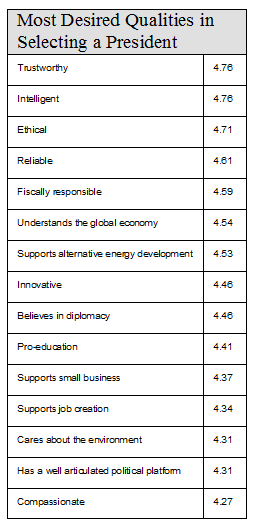
We first wanted to understand which personality attributes and platform issues were the most desired in selecting a president. They are as follows: (Please note: you can click to enlarge all tables)
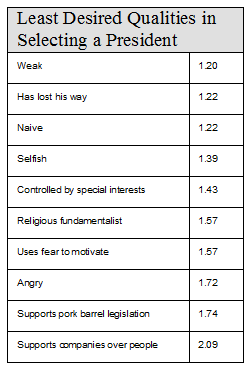
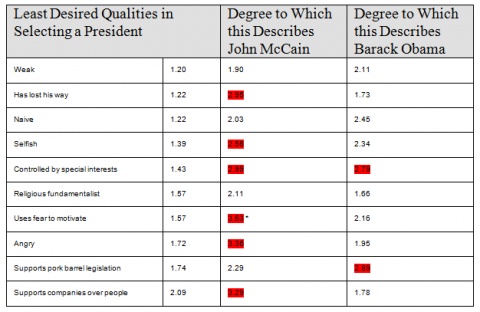
Related to that, we wanted to understand the least desirable attributes. They are as follows:
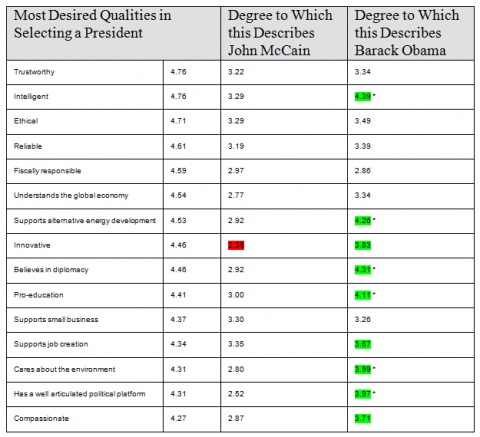
Then we asked people to what degree each of those attributes and issues were descriptive of each of the two presidential candidates.
Of the fifteen most desirable qualities of a presidential candidate, nine of them were perceived to highly describe Barack Obama: intelligent, supports alternative energy development, innovative, believes in diplomacy, pro-education, supports job creation, cares about the environment, has a well articulated political platform and compassionate. The other six were perceived to moderately describe Barack Obama. Of the fifteen most desirable qualities, fourteen were perceived to moderately describe John McCain. While one quality, innovation, was perceived to minimally describe John McCain.
Of the ten least desirable qualities, two were perceived to moderately describe Barack Obama: controlled by special interests and supports pork barrel legislation. The rest were perceived to minimally describe Barack Obama. Of the ten least desirable qualities, one was perceived to highly describe John McCain: uses fear to motivate. Five were perceived to somewhat describe John McCain: has lost his way, selfish, controlled by special interests, angry and supports companies over people. The rest were perceived to minimally describe John McCain.
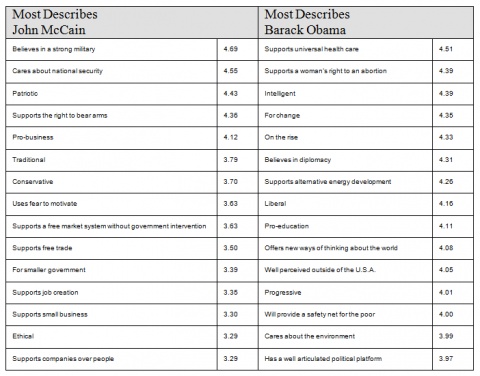
Overall, the qualities that were perceived to best describe John McCain relate to strength/force and patriotism (believes in a strong military, cares about national security, patriotic and supports the right to bear arms). Other top qualities relate to being traditional and conservative and supporting business (pro-business, supports a free market system without government intervention, supports free trade, supports small business, supports companies over people). John McCain is also perceived to use fear to motivate, one of the least desirable qualities in selecting a president.
Barack Obama is perceived to be intelligent and on the rise. Other qualities that were perceived to best describe him relate to his position on specific issues (supports universal health care, supports a woman’s right to abortion, supports alternative energy development, pro-education, will provide a safety net to the poor, etc.). Two qualities related to change were also perceived to highly describe him: for change and offers new ways of thinking about the world. Barack Obama is also perceived to believe in diplomacy and to be liberal.
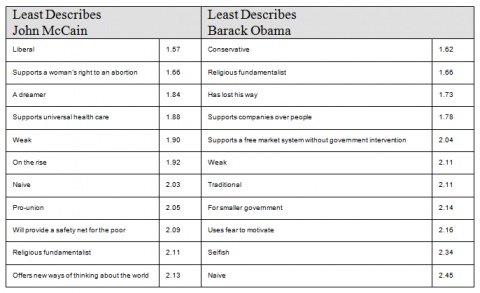
Liberal was the least descriptive quality for John McCain, while conservative was the least descriptive quality for Barack Obama. Neither presidential candidate was perceived to be weak, naive or a religious fundamentalist.
As this analysis clearly points out, there are significant differences between the two political candidate brands. John McCain is perceived to be more traditional, conservative and pro-business while Barack Obama is perceived to be more liberal, progressive and an agent for change. It would seem that John McCain’s brand would be more appealing to those who are motivated primarily by fear, while Barack Obama’s brand would appeal more to those who are hoping for positive change. While points of view vary, overall, Barack Obama’s brand is perceived to be much more closely aligned with the qualities the respondents to this survey say they most desire of a president.
The fear of loss has historically been a more powerful motivator than the promise of reward, often causing people to choose outcomes that are less than optimal for them. Given that the Barack Obama brand seems to be better aligned with what our respondents claim to value, the outcome of tomorrow’s presidential election will likely hinge on whether people’s fears overshadow their hopes or their hopes outshine their fears.
-This survey was created, fielded, and analyzed by Brad VanAuken, author of Brand Aid.
-For more on this, see me live tomorrow morning between 7am and 9am EST on Fox Business Network’s morning show Money for Breakfast.
-Congratulations to the winners of our survey incentives:
James Dickson from Kroger, Melinda Mengert from General Electric and Angelo Mancuso. Each will receive a copy of Brand Aid and generous gift cards for Amazon.com and Starbucks.
The Blake Project Can Help: The Brand Positioning Workshop
Branding Strategy Insider is a service of The Blake Project: A strategic brand consultancy specializing in Brand Research, Brand Strategy, Brand Licensing and Brand Education




One comment
Jonathan
November 4, 2008 at 11:19 am
It’s fascinating conversation, but I’m not sure that using ‘brands’ as a model for understanding or communicating political issues is terribly helpful, especially to the function of governance. I mused on it a bit today (after I voted, of course!): http://dimbulb.typepad.com/my_weblog/2008/11/president-not-a-brand.html
Comments are closed.