avatar_48x48
Contact BSI
Derrick Daye
888.706.5489 Email us

Category: Brands & Consumers

Brands & Consumers

Brands And The Power Of Choice

By

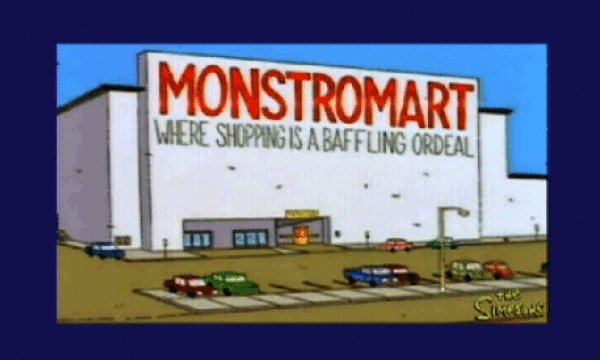
I swiped this cartoon image from a wonderful TED Talk by Sheena Iyengar on the art of choosing. If you are managing a brand, do yourself a favor and take some time to watch it. It has significant implications for brand marketers.

As I listened to her scholarly presentation, I thought how the power of choice affects our collective work in building the value of brands. Obviously choice, and more specifically free choice, is what we Americans have built our entire cultural narrative on over the past two and a half centuries. But is our cultural inclination for more and more choice really serving us? I ask the rhetorical question because I think it’s worth thinking about.

We have abundant choice. We are surrounded by options. This is not so in other parts of the world. It is interesting to note, that in those cultures where many choices have not been previously available, the sudden available of choice causes tremendous stress and anxiety for people. People simply have a difficult time sorting things out.  In some cultures, choosing for oneself is viewed as disrespectful to the harmony and collective well-being of all concerned. For example, in Asian cultures, it’s better to have the “buy-in” of others, particularly those who are admired and respected, who participate in the choices an individual makes. For these people community trumps individualism.

When it comes to the brandscape, our available choices in all product categories seems more and more endless. So much so that I am beginning to believe that choice is dumbing us down as a culture.

Don’t get me wrong, I am not advocating less freedom to choose. I’m simply throwing the idea out there that we might have more choice than is really good for us. At a minimum, we have more choice than what is truly useful to us. I don’t believe ubiquitous marketing online or off is helping bring more clarity to people about choice. More marketing and more choice just adds to the slush pile.

Read More
Brands & Consumers Derrick Daye

Consumer Expectations: A New High

By

Brand Strategy Consumers

No doubt, when Maryland state delegate Emmett C. Burns, Jr., penned his letter to Baltimore Ravens owner Steve Biscotti demanding that linebacker Brendon Ayanbadejo be silenced about his support of marriage equality, presumably by threatening his job, Burns had no idea what sort of rebuttal he was inviting. It didn’t take long for him to find out.

Ten days later, Minnesota Vikings punter Chris Kluwe posted an open letter to Burns at Deadspin.com taking him to task for the views Burns had expressed in his letter to Biscotti. Kluwe already had a popular following for his blunt, acerbic, occasionally vulgar, frequently derisive tweeting, but his letter to Burns was over the top. The New York Times described it as a “profanity-laden rant,” which doesn’t even begin to describe it. It was helmet to helmet, and it took Burns right out of the game. Kluwe’s letter ignited a firestorm of support, and 48 hours after it was published Burns conceded he was wrong.

But Kluwe – who had a perfect score on his verbal SAT and turned down Harvard to play football at U.C.L.A. where he earned a double major in political science and history – was doing more than showing off his compositional dexterity with George Carlin’s seven dirty words. His letter was also, said The New York Times, an “insidiously thorough” and “multilayered, point-by-point decimation of Burns’s argument.” Kluwe didn’t just rant; he made a reasoned, logical argument, but in a ranting style that Kluwe was quoted as saying “comes from a storied history on the World of Warcraft forum boards.” In other words, Kluwe argued in the mode and vernacular of the most popular MMORPG of all-time, which is to say the rhetorical style of contemporary popular culture.

Stay with me as I build towards an important marketing point.

Kluwe’s sharp, vulgar tongue wasn’t deplored; it was celebrated, left and right. Rush Limbaugh said of Kluwe’s letter, “It is profane. It’s funny; it’s humorous. The guy’s got a way with words.” St. Paul Pioneer Press columnist Bob Sansevere remarked, “[Kluwe] might be a better writer than he is a punter…I’ve never seen an athlete who can write like that.” Kluwe was not criticized for speaking with an uncivil tongue; rather, his utterly unfriendly, discourteous manner was praised. However abrasive, however brash, however crude, it was commended for a good turn of phrase.

Read More
Brands & Consumers

Consumer Behavior: Spenders By Nature

By

Brand Strategy Consumer Spending Brand Marketing

Consumers want to believe again. So help them.

People are tired of doing without. The term being bandied about right now by market observers is “frugality fatigue,” meaning the pent-up desire among hard-pressed, anxious consumers to pick up their buying. Obviously, some consumers remain too distressed for their spending to rebound. But most people feel hopeful about renewing their engagement with shopping.

Lots of signs point in this direction. Discretionary purchasing is up. Name brands and non-discounted fashions are doing better. High-end personal care products are growing. People are planning to dine out more, and when they do they are going to higher-priced restaurants, ordering appetizers again and spending more than they budgeted. More people are planning to spend their tax refunds instead of using them to pay off debts.

As we’ve counseled all along, there is no “new normal of frugality” setting in as the recession recedes.  Instead, as the economy is showing signs of strength, so is consumer spending.

This is to be expected. Americans are spenders not savers. It’s a myth that we’re thrifty; we’re not. We spend, and have always spent. We are unique in this way. This is not true in other developed markets. Brits and Europeans are savers not spenders. Sheldon Garon’s recent economic history, Beyond Our Means, shows that this difference is rooted in distinctive 19th century social contexts of moral suasion and political and charitable institutions.

People can’t spend if they don’t have cash or credit, which is where many consumers still find themselves nowadays. But in America, once people feel flush again, they spend. As Garon makes clear, this is cultural.

Read More
Brands & Consumers

Presidential Election Impacts Consumer Spending

By

Brand Strategy Presidential Election White House

The combative clamor of presidential primaries every four years can seem like the harbinger of something worse to come, and, alas, occasionally it is. But this time around, brand marketers are hoping that more comes out of it than just avoiding the worst; they want something good to happen. In particular, brand marketers would like for the tumult of 2012 electioneering to energize consumer spending.

There is some evidence that politicking helps pry open people’s pocketbooks. Rarely has consumer spending dropped during a presidential election year. The last time it happened prior to the 2008 year of the financial crisis was 1980. In fact, generally speaking, consumer spending tends to pick up in election years.

Business turnaround consultant Steve Hansen blogged about this phenomenon earlier this year at the investor blog, SeekingAlpha.com. He shared a chart with this question, “Is there something about elections that excites consumers?” Hansen’s chart showed that in five of the six presidential election years from 1988 to 2008, the annual growth in consumer spending exceeded the average annual spending growth over the entire period. The one exception was 2008.

This trend in consumer spending is paralleled by a similar pattern of improvement in consumer confidence. A review by the National Association of Realtors of the Conference Board Consumer Confidence Index from 1977 to 2009 found that confidence was somewhat more likely during election years to increase rather than decrease from October to November.

Read More

Get Two FREE Chapters Of Brand Aid

Subscribe to Branding Strategy Insider Now and get regular updates and two FREE Chapters of Brad VanAuken's best selling book Brand Aid direct to your inbox.

  • Rare Overview of the Entire Brand Management Process
  • Analysis of the 40 Most Common Brand Problems
  • 17 Checklists Covering All areas of Brand Management
  • The Indispensable Guide for Building Strong Brands
Subscribe

Your information is Safe and will never be sold, traded or shared.