

avatar_48x48
Contact BSI
Derrick Daye
888.706.5489 Email us

Archive for September, 2012

Brand Management Derrick Daye Industry Issues

Brand Marketing Shift: Attitudes Follow Behavior

By

Brand Strategy Customer Behavior

The debate over which comes first, attitudes or behaviors, has been going on for a long time. But a lot of recent evidence seems to be tipping the scale in favor of behaviors, which is to say that, people act, then form attitudes after the fact consistent with their behaviors. If true, much of what brand marketers do needs to be seriously reconsidered.
Probably the best-known theory lending support to the notion that behaviors cause attitudes is Leon Festinger’s classic theory of cognitive dissonance. Strictly speaking, Festinger’s focus was on dissonance between attitudinal beliefs, but his theory helps explain things like the shifts in consumer attitudes typically observed after big-ticket purchases. People actively seek to assuage buyer’s remorse through a process of post-purchase rationalization in which they come to like the product they have already bought even more, boosting their attitudes about it relative to competition and downplaying concerns or perceptions of defects and shortcomings. It is the behavior – the purchase – that causes attitudes to change.

Another well-known empirical result showing that behaviors change attitudes comes from research into brainwashing techniques used on American POWs during the Korean War, as explained in detail by former Arizona State University psychologist Robert Cialdini in his highly regarded bestseller, Influence: Science and Practice. One technique was to force prisoners to sign essays denouncing the U.S. irrespective of the fact that these prisoners did not believe a single word of what they were being forced to sign. But despite the duress and divergence from beliefs, this technique worked to increase the likelihood that a prisoner would voluntarily engage in later acts of collaboration with his captors. The dynamic at work is one of consistency. Having made a small behavioral commitment, even under pressure, subsequent acts and attitudes seek to maintain consistency with this small first step. Over time, such small steps can add up to very big changes in attitudes.

Read More
Brad VanAuken Slogans/Taglines/Jingles

Brand Strategy: AVIS Abandons Trying Harder

By

Brand Strategy Avis Tagline

After 50 years of “We try harder,” AVIS Car Rental has announced that it will replace that slogan with a new one, “It’s your space.” When introduced, “We try harder” was lauded as a brilliant counterpoint to Hertz’s #1 position in the car rental industry. It was a strong brand promise that played off the belief that the #2 car rental company would work harder on a customer’s behalf.
Since the introduction of that slogan, the competitive landscape in the rental car industry has gotten more crowded and more challenging. Having used most of the rental car brands myself, I can confirm that Enterprise has consistently shown that it tries harder in the area of customer service. Perhaps, that’s why AVIS finally walked away from its much-lauded slogan.

While I can understand that “It’s your space” is customer focused, it is not a promise and I am unconvinced that it differentiates. I am sure a great amount of brand research went into the development of the new tagline (or I at least hope it did). But I just don’t get it. As a very frequent business traveler, I am not compelled to use AVIS based on this new slogan.

I will withhold judgment until I have seen the marketing campaigns associated with this slogan unfold, but, for now, all I can say is, “huh?”

What is your opinion?

Sponsored ByThe Brand Positioning Workshop

FREE Publications And Resources For Marketers

Read More
Branding and Social Media Derrick Daye

Brand Marketing: Powerful Networks And Weak Ties

By

Brand Marketing Social Networks

A recently published study in Nature has been making minor headlines with its findings that close Facebook friends can boost the likelihood to vote. This study has caught the eye of brand marketers because these findings seem to validate the investments being made nowadays in viral marketing, particularly those involving online social networks. But it shouldn’t come as a surprise that people are influenced by their close friends. Instead, what’s surprising about this new study is just how weak this influence tends to be.

On the day of the 2010 mid-term elections, Facebook featured a News Feed message encouraging people to vote, with a link to find polling places and an “I Voted” button to click on. Most of the 60+ million people who visited Facebook that day also saw profile pictures of friends who had already clicked the “I Voted” button. Researchers carved out two randomly selected comparison groups, one that got everything in the News Feed except the profile pictures of friends and another that got nothing at all in the News Feed. The analysis looked at the impact of the message, both with and without profile pictures of friends, on the likelihood that someone would subsequently click on the “I Voted” button.

By the researchers’ calculations, the message with profile pictures of friends generated an additional 340,000 votes, of which 60,000 were directly influenced and the rest through a chain of social contagion. Moreover, the friends that accounted for the social contagion were close friends, hence, the headlines that strong online social ties influence the likelihood to vote.

But the researchers were mindful that the results were not unambiguous. Clicking the “I Voted” button is a far from a perfect measure of actual voting. More problematic is causality. It’s unclear whether these 340,000 people would have voted anyway and simply saw the Facebook News Feed first by serendipity. Most problematic is figuring out whether Facebook added anything unique. Since the friends that mattered for social contagion were close friends, some portion of the measured Facebook effect may not be due to Facebook at all but to other forms of equally influential interaction, an issue the researchers noted.

Read More
Brad VanAuken Branding Basics

The Brand Defined

By

Brand Strategy Brand Logos

Now that we have thousands of blog posts on the topic of brand management here on Branding Strategy Insider, I thought it was time to revisit what a brand is. I will list my favorite definitions but hope that you will also add your favorites to the list.
  • A brand is the source of a promise to its customers. It promises relevant, differentiated benefits.
  • A brand is the personification of an organization and its products or services. It has a personality and character and can be trusted or not.
  • A brand resides in the mind of the customer. It is the sum total of all experiences and associations that the customer has with it.
  • A brand consists of identity elements that link to associations in the customer’s mind.
  • A brand is a gut feeling about an organization and its products and services.
  • A brand is a promise consistently made backed by an experience consistently delivered.
  • The primary indicator of a brand is the ability to charge a price premium over commodities in the same product/service category.
  • A brand indicates the unique source of a product or service.
  • The brand is the story behind an organization and its products and services.
  • A brand is the identity applied to an organization and it products and services.
  • A brand is the value delivered above and beyond the functional value of the product or service (or the book value of an organization)

Sponsored ByThe Brand Positioning Workshop

FREE Publications And Resources For Marketers

Read More
Brad VanAuken Brand Architecture Branding: Just Ask...

Brand Architecture Strategy

By

Brand Architecture Strategy

Today on Branding Strategy Insider, we're taking another question from the BSI Emailbag. Manuel, a student of marketing in Frankfurt, Germany asks…

“I’m studying market research and we recently discussed brand strategies. The topic was why companies like Procter & Gamble and Unilever are moving from managing and marketing their brands separately to leading with their company brand.” 

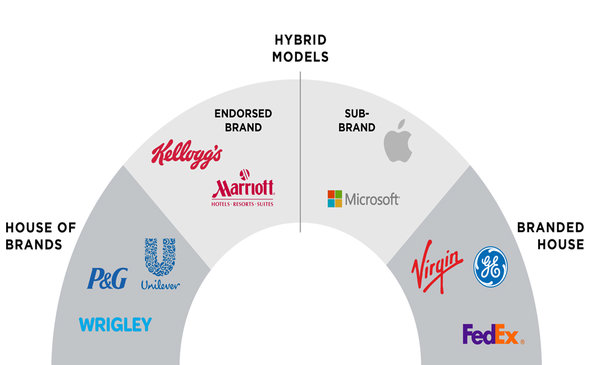
Thanks for your question Manuel. You may have heard the term, "House of brands versus branded house." Nowadays, most organizations have chosen the brand architecture strategy, branded house. That is, they have a corporate, parent or umbrella brand. If this is the only brand that they use on all of their products and services, they are pursuing a master brand strategy. If they also have other brands, those other brands are typically sub-brands of the parent brand or endorsed by the parent brand. But, in almost all cases for branded houses, their products and services feature the corporate, parent or umbrella brand, even if other sub-brand and product names are also used.

As you point out, the classic consumer product companies such as Unilever, P&G or Kraft historically were houses of brands in which each brand was managed and marketed separately. And the corporate brand was not featured on the products themselves. Why would these companies move to a strategy like Virgin's in which they are putting the corporate name on more of their products? For a few reasons: (a) credit can begin to go back to the corporate or parent brand from each product category in which the company operates, (b) the corporate or parent brand can convey quality and other assurances for the individual product brands and, perhaps most importantly, (c) in the long-run, some of the currently individual brands could be more easily converted to the parent or corporate brand, saving the company significant money in brand building campaigns.

We hope this was helpful Manuel. Here's more on branded house and house of brands strategy.

Have a question related to branding?  Just Ask

Sponsored by: The Brand Architecture Workshop – ask us for more.

Read More

Get Two FREE Chapters Of Brand Aid

Subscribe to Branding Strategy Insider Now and get regular updates and two FREE Chapters of Brad VanAuken's best selling book Brand Aid direct to your inbox.

  • Rare Overview of the Entire Brand Management Process
  • Analysis of the 40 Most Common Brand Problems
  • 17 Checklists Covering All areas of Brand Management
  • The Indispensable Guide for Building Strong Brands
Subscribe

Your information is Safe and will never be sold, traded or shared.