

In an era of crowd sourcing and online $100 logo design, the specialized skills and talents involved in identity design are seemingly being marginalized even further. Are big iconic brands moving in that direction?
“If, in the business of communication, image is king, the essence of this image, the logo, is the jewel in its crown”. – Paul Rand
Throughout the brand strategy and marketing blogosphere, there’s been a lot of buzz and chatter about the recent logo / identity changes Starbuck’s has implemented to help it move closer to its next incarnation. A few months back, the Gap made a similar move with less favorable reviews.
In both these instances, it’s pretty clear people in our business continue to care about these changes. The question is–do customers care? Do they really care what your logo looks like? Does it matter that much to your marketing success?
In my view big brand identity changes of any kind illustrates a couple of interesting points. Mainly that people pay attention to the marketing shifts brands they care about undertake. Secondly, there appears to be a huge gap in people’s understanding of the difference between a trademark and a brand. They are not one and the same. And finally, the critical importance of brand management to align all customer facing communication (of which trademarks are a primary component) to evolving strategic imperatives that effect business performance in the future. The stylistic aspects of these types of changes are less important than the potential to diminish brand meaning in the process.
Generic corporate and brand identity: a growing trend?
Throughout my marketing career, the heart of my work has always been centered in the discipline of corporate and brand identity design. Certainly it has been in my own interest to care passionately about the value that visual design adds to building a strong identity in the marketplace. Lately, I’m not so sure visual design, and the management of visual brand assets, really matters to anyone but designers. In an era of ubiquitous online $100 logo design, the specialized skills and talents involved in identity design are seemingly being marginalized even further. And now big iconic brands seem to be moving in that direction.
After the Gap’s generic logo appeared, I was even less confident that marketers value the specialized expertise involved in creating trademarks that reflect, enhance and enable positive business outcomes. I began to wonder if there is a growing trend these days for brand marketers to devalue their brands by being represented in the marketplace by generic trademarks. After all, the sole purpose of a trademark is to provide differentiation between brands.
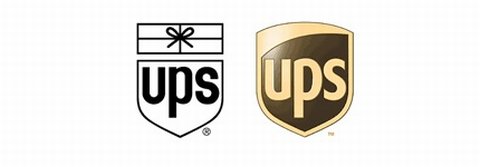
Thinking back on it, I remember how sad I was to see Paul Rand’s elegant package symbol for United Parcel Service be cast away in favor of a generic shield with a monogram letterform– so commonly delivered by the big branding consultancies today. Identity designers like Rand and his contemporaries (Saul Bass, Walter Landor, John Massey, Ivan Chermayeff, and the early founders of Pentagram) represent a school of thought few clients embrace these days. Identity design today seems to be more of a crowd sourced decorative act rather than a strategic business imperative.
Corporate brand identities evolve over time.
Business, markets, products, management, cultural trends all change over time. Likewise, the corporate or brand identity evolves in a similar path along with the organization it represents. Starbucks is just one of hundreds of iconic brands whose identity has evolved with the pace of organizational and cultural change. There is nothing new here.
The decision to drop the associated typography from the Starbucks symbol is one that many iconic brands have made (Nike, Apple, McDonald’s quickly come to mind). Whether this supports the strategic imperatives facing Starbucks’ next level of growth remains to be seen. But the visual design tactic is hardly without precedent.
What’s important are the associations people have with a logo–not the logo itself. A logo (trademark and its associated visual language) is the symbolic representation of a whole narrative story built into an organization over time. Brand equity is the result of successfully delivering on the promise your brand represents in the hearts and minds of consumers. Indeed, there are some time-tested design guidelines all enduring trademarks share, but that is not what enables them to endure. What makes a logo endure (and be cared about) is not the design, but the promise it represents.
At the end of the day, consumers (and all other stakeholders) care about the promise delivered. In time, people will accept whatever symbolic form the brand’s promise represents. In a me-too marketplace, the importance of developing and managing a highly differentiated brand identity is more critical than ever. It’s still my passionate belief that the specialized discipline of corporate and brand identity design brings tremendous value to how the promise people care about is best represented and managed.
The Blake Project Can Help: The Brand Positioning Workshop
Branding Strategy Insider is a service of The Blake Project: A strategic brand consultancy specializing in Brand Research, Brand Strategy, Brand Licensing and Brand Education





11 comments
Greg
January 21, 2011 at 11:04 pm
The only advantage I can see in going with a symbol only logo is if the brand is trying to establish a global presence, free of language barriers. I admit I am not familiar with Starbucks business, but going word free might be worth it globally in the long run.
Anthony Begnoche
January 22, 2011 at 2:24 am
All the “classic” logos tell a story. Today’s replacement logos say as little as possible. It’s an interesting turn and an ever-evolving one. Has a logo’s job description changed? Does our media-centric culture and highly exposed consumer negate the need for a story communicated from the top down? Seems like it for now. While the brand and the “brand experience” rein supreme, it no longer seems to originate with an original logo, which is indeed a sad turn of events.
I have a feeling it’s cyclical, once the market is saturated with generic, cliche, $100 logos the savvy business will turn back and look for something more unique.
Marino Fadda
January 24, 2011 at 3:34 am
Starbucks is becoming a global brand. All customers in the USA, Japan, Europe, etc., know the old logo. But the mermaid is a complex design: what does the new Starbucks logo mean?
Strong logos are metaphors for meaning. They convey a concept, promise or values that ‘work’ for the brand.
It is incredibly hard to build brand name recognition in our competitive world.
In the marketplace, it’s the Starbucks’ name that matters. I think if your name is recognized favorably don’t change it.
David Airey
January 24, 2011 at 8:09 am
You can’t look at a logo in isolation to gauge its value to a company. Consistency across a wide range of marketing collateral, and how the design can “move” into new media, are more important than ever.
It’s this necessary context that’s painfully missing from cheap design.
Rick
January 24, 2011 at 10:56 am
The question is–do customers care? Do they really care what your logo looks like?
Have they ever? I don’t think its their job to care, any more than its their job to care what products you’re developing, or what your business model looks like. Customers either relate to you or they don’t — it’s company’s job to create a consistently attractive brand that reaches those customers on a gut level.
But that doesn’t mean the design isn’t important, or that generic logos work just as well.
The logo’s role is to accurately represent the brand. Obviously, a logo that says “coffee” can be jarring if you’re trying to sell shoes.
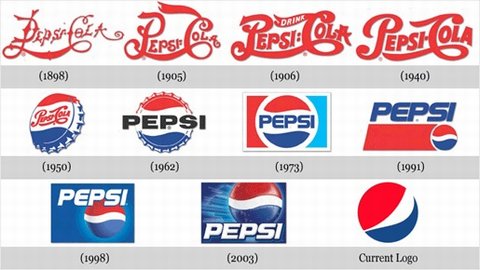
But there’s also an element of fashion in a logo (as illustrated by your Pepsi graphic above). As for UPS, the clean-line logo, as nice as it may be, looks dated next to the trendy 3D shield. UPS was striving to be “today’s” carrier, and (I’m guessing) went looking for a more contemporary badge. Generic? Perhaps, but now they can try to pal around with the cool kids.
If a company wants to be perceived as innovative, cutting-edge, youthful, etc., the logo may need a new tattoo and a trip to the mall. Of course, if the brand is really your dad, the faux-hawk is going to look kinda creepy.
IOW, the logo can’t dictate the brand, it has to reflect it. Logo evolution works when the design reflects an evolution already underway within the corporate strategy and/or culture.
… Which is pretty much what you were saying, I think. So, nice article. 🙂
Luckylou
January 24, 2011 at 6:51 pm
While it’s certainly possible consumers don’t care much about the logo, and possibly fewer in our business do either, it is true that well-executed, relevant design adds real value to a brand.
Brands that choose to ignore or downplay this do lose out on the opportunity to maximize their touchpoints’ effectiveness that a truly great logo brings.
Neil Hopkins
January 26, 2011 at 11:23 am
The problems with crowdsourced and $100 logos is that they often won’t support the deeper brand positioning and objectives.
And since the logo is often the first and most recognisable element a consumer will come into contact with, it needs to be right.
Identity is key for this. Because, to me, identity is linked to personality.
My identity, as a human being, is linked to my face, my physical presence, my personality, the impact I have on those around me etc.
And I don’t think that it should be any different with logo creation. A strong logo should be both iconic and fitting to the brand’s deeper core meaning…
Customers (not brand evangelists) probably only care about the logo in so far as it helps them to recognise the product in question – it’s a visual reference point. I’m not sure that they’ll associate all of the brand meaning from the logo alone – but rather from what the logo is stamped on…
And as others have said, implementation is of prime importance, whatever the core values are.
Franklin Grippe
January 26, 2011 at 5:36 pm
I believe that brand identities/logos are as important as ever as differentiating component of a brand. However, I think that it is important to begin an evaluation of these signs as precisely that; a component; a part of the whole.
Because a brand is contextual, its meaning is never completely stable(however low it is oscillating). It influences, and is influenced by, a myriad of forces, constantly ebbing and flowing. Because it is innately dynamic, and in a constant state of transition, its has never been more necessary that a brand be in its most meaningful, relevant state, and therefore, differentiated at any given time. A brands continual calibration to the marketspace is crucial.
Part of this calibration involves the evolution of the identity/logo. And depending on the context of its usage, and the meaning it is required to represent, it may adjust more often or change more slowly. Burton Snowboards logo usage is highly variable according to its tribe, so to speak. GE’s identity changes more subtly over time. (although i might argue that Imelt has influenced a much more adaptable perspective to its marketing as of late, but that is another discussion)
But whether its highly variable, or slowly changing, I think we are seeing a common progression/pattern of change. An identifiable adaptation to market forces over the long haul.
May I suggest it goes something like this:
Federal Express shortens to FedEx, then to simply a colored shaped. Or like the Pepsi example above. Logos and what they represent become much more refined.
This progression/pattern is influenced in part, by forces such as the shear amount and kind of branded communication. Perhaps it is partly fostered by techniques we develop to make sense of this information overload, such as what hypertextuality represents. Simply put, the complexity in our communicative activity is increasing by several orders of magnitude.
So a kind of visual shorthand emerges. A visual shorthand that represents an experience or a feeling, where it represented much more of a tangible concept before. Not only is it cognitively easier for us to process information in a much more fuzzy way when there is a lot of it, rather than specific data points, but it may provide a much more “sticky”, cognitive connection to the brand.
I think this is evidence that we are undergoing a fundamental shift in how we communicate. From that of concrete and obvious meanings/concepts to fuzzy, emotions/feelings/experience. And our visual language is therefore adapting and evolving, and pattern recognition is key.
I also think this is where a lot of the problems emerge. Firms like the Landor’s of the world are stuck in outdated testing and measurement. Because for all the time they spend and money they are paid, seldom do I see a great result from their activity. Or the professional services firm that has all kinds of MBA management consultants, and heavy duty business thinking, that is so formula it manifests itself as bad taste, and there creative is cliché’ and predictable.
Or executives that are thrust into marketing activities that do not have the skill set to properly evaluate and manage brands and lead to debacles like the Gap logo incident. And you can’t tell any of these guys any different, because they are making money.
However, I don’t think they realize how much more they would make if they evolved their approach. The best of the advertising agencies, however, get this the most. I have been in the graphic design camp and the professional services/integrated marketing camp, etc., and in my opinion, the most artfully engineered, branded communications, come from the aforementioned skill set. They always have been first and best at keeping up with how branded communication evolves, because they usually have the advantage of looking at brand from 50,000 ft. They look at the big picture and see it holistically, because they have to. And to their credit, have been the most effective at synthesizing disparate skill sets, and knowledge, along with being cognizant of social trends, and having great formal design sensibilities.
Additionally, I think that people with skill sets like those of a great ad agency will ultimately be in the most demand. A new kind of engineer of experience/emotions/feelings. Engineering so artful it is invisible. Seamless. And necessary towards the goal of sustainable competitive advantage.
Brian James
January 26, 2011 at 6:04 pm
I think customers are as brand conscious as they ever were. With the globalization of our society and the speed of communication through the media at our fingertips, a visual shorthand can be a positive thing for a brand looking to expand their reach. Changing or updating your logo/trademark can be a positive or a negative depending on the execution. To me it signals that Starbucks has reached that place that requires no embellishment. The rarified air of companies like: Nike, McDonalds & Apple. These are iconic brands and to include the typographic name with the symbol becomes redundant. I always wondered why Shell Oil, whose logo was a obviously a shell, felt it was beneficial to add the word “Shell” across their symbol.
Katelnielsen
January 27, 2011 at 7:08 am
Good to hear the perspective of someone other than designers. I wrote a piece for Design Assembly along similar lines last year after the Gap debacle.
http://www.designassembly.org/2010/09/03/when-to-leave-the-logo-alone/
Chuck Lytle
March 28, 2011 at 4:34 pm
Brands and their identity is part of the promise they deliver as a whole. The logo can be a great symbolic representation of the brand itself and is a vital aspect to it. Every time people think of your brand, they generally associate it with a logo. It helps differentiate the brand from other similar brands. However, the name is the most important part to the identity of the brand. When people think of “Starbucks” for example, they think of all the qualities associated with it and not necessarily the logo.
However, the logo has to be creative and serves the purpose as the brands face so consumers can recognize. Logos change because the identity of the company changes and culture changes. Pepsi changed their logo to match their new brands identity and to stay relevant in the current culture. Logos are the face of the brand and show a visual picture of their identity in order to differentiate them from other brands.
Comments are closed.