

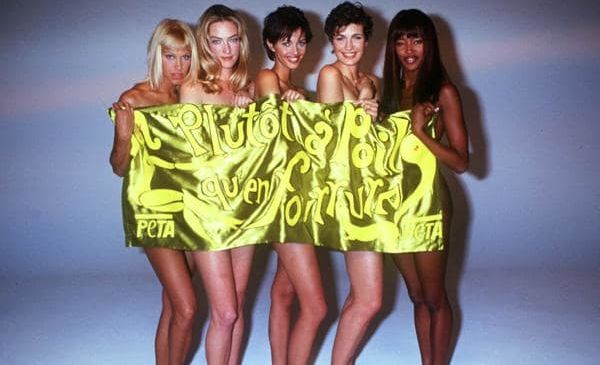
What a difference a decade plus four makes. Back in 1994 Naomi, Claudia, Kate and Elle were at the height of their supermodel powers, naked as the day they were born and united in preferring to be that way than wear fur.
Sales of fur had been flat for years and many furriers had closed their doors in despair.
Fashion is, unfortunately, all about change, and today, supermodels are actively clothed in, and sponsored by, the very material they once denounced.
Vogue is filled with the latest celebrities modelling the hottest labels, featuring the finest furs. Designer brands such as Prada, Dolce & Gabbana and Alexander McQueen have all recently featured fur in their run-way collections. Now, high-street fashion brands such as J.Crew are following suit.
More worryingly, PETA (People for the Ethical Treatment of Animals) is beginning to lose its strong influence over the fashion world. Today, its message is sponsored not by Paris or Nicole, but decidedly B-list celebrities such as Heather Mills McCartney and ageing rock band Motley Crue.
Its tactics are growing increasingly predictable and, therefore, ineffective. Creaming Anna Wintour, the fur-loving editor of Vogue, with a tofu pie may have made the headlines, but it was hardly likely to influence her editorial stance.
No picture better captures PETA’s waning impact than photographs from its invasion of McQueen’s runway show. While campaigners hold aloft banners proclaiming ‘Fur kills’, the British designer laughs wildly at the commotion and mugs for the cameras. PETA’s approach was not only ineffective, it probably added to the notoriety and, therefore, popularity of the McQueen brand.
The problem for PETA is a common one: ignorance of brand equity. Brand managers often attempt to build brands generically, using the same tactics that worked on the previous brand they represented.
This is a strategic mistake. A brand is the opposite of a generic, which means the tactics and approaches that worked for one brand will inevitably fail on another.
In PETA’s case, the same logic applies, despite the fact that it is trying to break brands, not build them. The weak spot of any organisation is its brand equity, but to hurt a brand, first you must develop tactics specifically attuned to its particular equity.
In the 90s, lesbian activists, unhappy at their lack of representation in Nike advertising, created an alternative brand called Dike. It copied the sports brand’s iconography and sold counterfeit goods to members of the gay community in such numbers that Nike finally made some concessions.
In the 80s, the eponynmous founders of Ben & Jerry’s famously saved their brand from bankruptcy by picketing the headquarters of Pillsbury, the conglomerate that owned Haagen-Dazs, following an attempt by Haagen-Dazs’ management to strangle Ben & Jerry’s’ distribution.
The danger to Pillsbury of it appearing un-American and the threat of a potential boycott of hundreds of its brands forced it to capitulate.
If PETA is to reclaim its power over the fur industry, it must somehow devise similarly brand-specific strategies. I wonder if Landor or Prophet would consider some pro bono work?
I could certainly provide a list of several senior brand managers who, if employed by a fur brand, would do enormous (albeit unintended) damage to their new employer in relatively short order.
Humor is not the answer; certainly not having watched the video footage on PETA’s website of thousands of cages packed with Chinese dogs and cats, bloodied and bullied, awaiting their execution, all in the name of fashion.
PETA’s current brand strategies might be ineffective, but it has one hell of a website.
The Blake Project Can Help: The Brand Positioning Workshop
Branding Strategy Insider is a service of The Blake Project: A strategic brand consultancy specializing in Brand Research, Brand Strategy, Brand Licensing and Brand Education




2 comments
Gareth
November 20, 2008 at 10:51 am
The main problem with PETA is that despite the anti-fur campaign being quite moderate and gaining widespread popular support, the organization’s goals are far more radical.
They are not just an anti-fur organization, they are essentially against consumption of any animal products, however humanely they are produced.
PETA is a fringe organization which has, quite rightly, been relegated back to the fringe.
Susan Gunelius
November 20, 2008 at 11:53 am
This post is very timely for me. I had a chance to provide my opinion on PETA’s marketing strategy to PETA a few weeks ago. After reading your post, I decided to publish the note I sent to PETA on my blog.
I agree with you that it’s time for a PETA brand strategy overhaul. If you’re interested, you can read what I wrote to PETA here: http://keysplashcreative.com/time-for-a-peta-marketing-strategy-shift/
Comments are closed.