

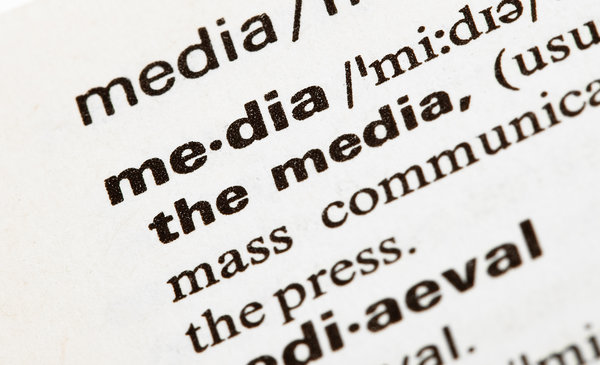
Get a dictionary and look up the word media. It will contain several different definitions, but this is the meaning that, as a marketer, you will probably be most comfortable with – media, n. : The main means of mass communication, esp. newspapers, radio, and television, regarded collectively.
This is what marketers mean, and have always meant, by the concept of media. It is the classic agglomeration of channels that they consider, plan, buy and evaluate in order to communicate their messages.
In recent years, many marketers have spoken of the media mix or medianeutrality, implying that they no longer prioritize any one channel over the others in their campaigns. Most marketers have added interactive, too, because that is the modern thing to do. But, generally speaking, their definition of media fits nicely with the one the dictionaries have offered us for the past 100 years.
Now go back to the dictionary and look up ‘medium’. Again, there will be several entries, but the one that applies to the world of marketing is likely to read something like this – medium, n. : An intermediate agency, instrument, or channel; a means or channel of communication or expression.
This is a very different definition from that for ‘media’. There is no reassuring emphasis on the ‘main’ means of communication, and this time there is no guidance in the form of a list of the ‘especially’ relevant channels. The definition of ‘medium’ is much more open and wild than its pluralized form. It is a definition that challenges us to think broadly and idiosyncratically, predicated as it is on a tabula rasa, rather than the status quo. And it is a definition much better suited to the challenges of marketing in 2008.
Radical new mediums spring up on an almost daily basis, leaving marketers struggling to even understand them, let alone plan or measure them. There have always been wacky alternative advertising media, be it dogvertising or forehead sponsorships, usually as the humorous ‘and finally …’ to the evening news. But what makes these latest media so different and important are the numbers attached to them. Second Life has about 1,359,611 regular users and brands such as Coca-Cola are using it as a marketing medium. Myspace has 110m users and 300,000 new ones join each day. Meanwhile, over at YouTube, users will view more than 150,000 videos today.
Aside from their vast audiences, these three mediums have one other thing in common: none of them existed five years ago.
Marketers have become lazy in their definition of media. They pay lip service to the idea of media fragmentation and interactivity, but then continue to fall back on dilapidated, 20th-century channels such as ITV and the Daily Mail. They have forgotten that anything can and will be a medium. The target audiences of 2008 are about to remind them…again.
The Blake Project Can Help: The Brand Positioning Workshop
Branding Strategy Insider is a service of The Blake Project: A strategic brand consultancy specializing in Brand Research, Brand Strategy, Brand Licensing and Brand Education



One comment
Lyndon Lawrence
April 15, 2008 at 9:07 am
Hi Mark,
I could not agree with you more. Seeing from things the respective perspectives of the client, the agency and the independent outsider, I can only but agree with you. A radical ‘new’ approach needs to be taken on how media is viewed and worked with. To me, everything has the potential to be a medium and thus, collectively or collaboratively, media.
The “build it and they will come” [sorry for flogging this already almost dead horse!] type thinking of the early web, got replaced and updated with banners and other odds and sods, finally giving way to ‘viral marketing’ and then some. Now we have ‘social media’ and a slew of other terms I’m sure I’ve not heard about yet. I do think that we’re at a “next step” though – or rather there is a potential for a next step if at least one or two CMO’s will decided to ditch their present way of thinking and try something new.
I’m even going to suggest, that part of this new approach is to put media at the very beginning of a campaign building process. Think about the audience first. Pick your media – and develop for those particular media – and if it makes sense – link them altogether. And I think that it is not the media agencies that should be deciding what should be picked, but the client or brand should decide – if even in consultation with leading minds – that they should be in charge.
However they need to – pick the best media / medium for their target audiences – because I feel that the decisions that are presently being made are too generic and ultimately wasteful. Maybe if CMO’s were actually aware of the alternatives out there, they might be more willing to accept and at least trial a few different approaches.
The time has come to take another point of view, maybe develop a roadmap, get excited about exploring new opportunities and frontiers.
Best,
Lyndon
Comments are closed.